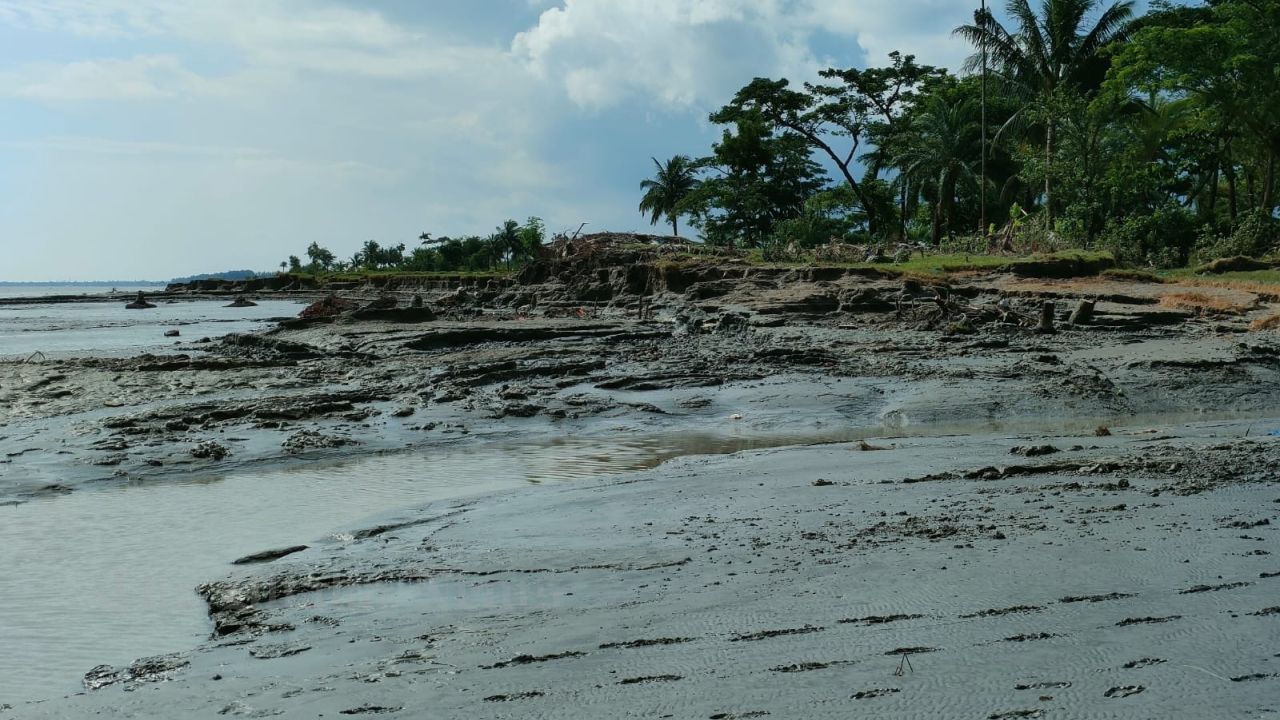
Hatiya Ravaged by River Erosion, Development Exists Only on Paper
Hatia is one of the most neglected and troubled islands in Bangladesh, and one of the main problems of this island is river erosion. And the river erosion of the island has become a national disaster. Every year, thousands of houses and lands are washed away by the strong current of the Meghna. There are projects and money is being allocated, but there is no timely work, no sustainable action.Hatia is not just an island today. It has become a path to a ruin. The houses, schools, colleges, mosques, cemeteries of this town are all being lost to the river. About 20,000 families have been victims of river erosion in the last decade. In the past few years, at least 8 kilometers have been washed away by the Meghna river erosion. No effective action has been taken to prevent erosion. Only assurances and stories of paper projects. Every year, crores of taka are budgeted to prevent river erosion, but in reality, little work is done. Projects come, tenders are made, but the work is only in name. In the last 10 years, about 10,000 families have become destitute due to the erosion of the Meghna.The biggest sorrow of about 750,000 people of the neglected, troubled Hatiya Island is river erosion. Every year, houses, croplands, schools, mosques, cemeteries, large buildings and markets collapse due to the turbulent waves of the Meghna. This erosion, which has been going on for years, has made the people of Hatiya destitute and homeless.Thousands of families on the banks of the river are constantly in fear due to the erosion of the river. It is sad to say that despite the government's messages of hope at various times, there has been no permanent solution to this problem.The people of Hatiyar Harni, Chanandi, Sukhchar, Nalchira, Charishwar and Sonadia unions are the biggest victims of this erosion. Since independence, many primary schools, mosques, madrasas, government and private buildings, and traditional markets have disappeared into the river. As it has been eroding for a long time, thousands of families have already lost their homes and become refugees. Even after changing their places several times, their homes were not saved. Many have even lost the courage to dream of building a new house.In the Banglabazar area of Charishwar Union, an old woman was seen staring blankly at the river after losing her land. She seemed to be saying something incoherently. A few women in their fifties were walking around their empty houses next to them. What should she do? It is a cruel irony of fate.Shobha Rani (55) said, two sons catch fish in a man's boat. We spend our days on whatever little we bring. There is no provision for food anywhere. A girl is of marriageable age. This is like a cut in the throat. I don't know what to do.We spoke to old man Rabiul Hossain (65). He said, there was once a place and land. There was a school and a mosque in front of the house. It has been destroyed by river erosion seven times. Now we are somehow living on the very slope of the river. I cannot stay in the house when the tide comes. The current house will not survive this monsoon. I can't afford to go up and build a permanent house. I have been hearing for a long time that a block dam will be built here; but in reality there is no news.Zakia Khatun (60), who is sitting in her empty house on the bank of the river, said, "My husband died 20 years ago. The river has taken away the house four times. Now the house is empty. But I can't afford to take a place to sleep. At night, I stay in someone else's house. During the day, I work on people's houses, eat if I can, and fast if I can. No one will look after us.It's not just Shobha Rani or Rabiul Hossain and Zakia Khatun, hundreds of people like them are losing their land to the river every year. Without any government assistance, they are taking shelter along the embankment, in government khas land or in the houses of relatives.Locals said that the erosion of the Meghna increases every year during the monsoon season. However, this year the level of erosion is much higher than in the past. This has put the surrounding areas, including the market, under threat. Despite repeated demands to the Water Development Board for a long time to prevent river erosion, no permanent project has been implemented.They also said that due to river erosion, not only are the people of Hatia losing their homes, but also their only source of livelihood, their cropland. As a result, farmers are unemployed and facing extreme crisis. Fishermen are also staying away from fishing in the terrible shape of the river. Poor people are struggling to get their daily food. At the same time, students are being deprived of education, teachers are being transferred elsewhere, and parents are becoming disoriented about the future of their children.The Sub-Divisional Engineer (Hatia) of the Water Development Board said that protective embankments using geo bags are underway in several places in Hatia to prevent river erosion. In addition, defense work has started in the ghat area using geo bags and geo tubes. This time, temporary defense work has been undertaken after the cyclone. We are working as much as possible to prevent river erosion.An engineer from the Noakhali District Water Development Board said, Hatiyar river erosion is an old problem. The reason for repeated erosion here is the change in the course of the river and strong tides. As long as permanent river management and bank protection dams are not built, this suffering will continue. We have visited the affected areas. A report has been sent to the ministry. However, the issue of project approval and implementation depends on the decision at the central level.Hatiyar river erosion is not just a natural disaster, it is now a humanitarian disaster. The way people are constantly losing everything and becoming destitute, it seems that the people of this region are a missing community deprived of the light of the state. Therefore, the people of Hatiya have sought the intervention of Prime Minister Tarique Rahman to prevent river erosion.
.png)