.png)

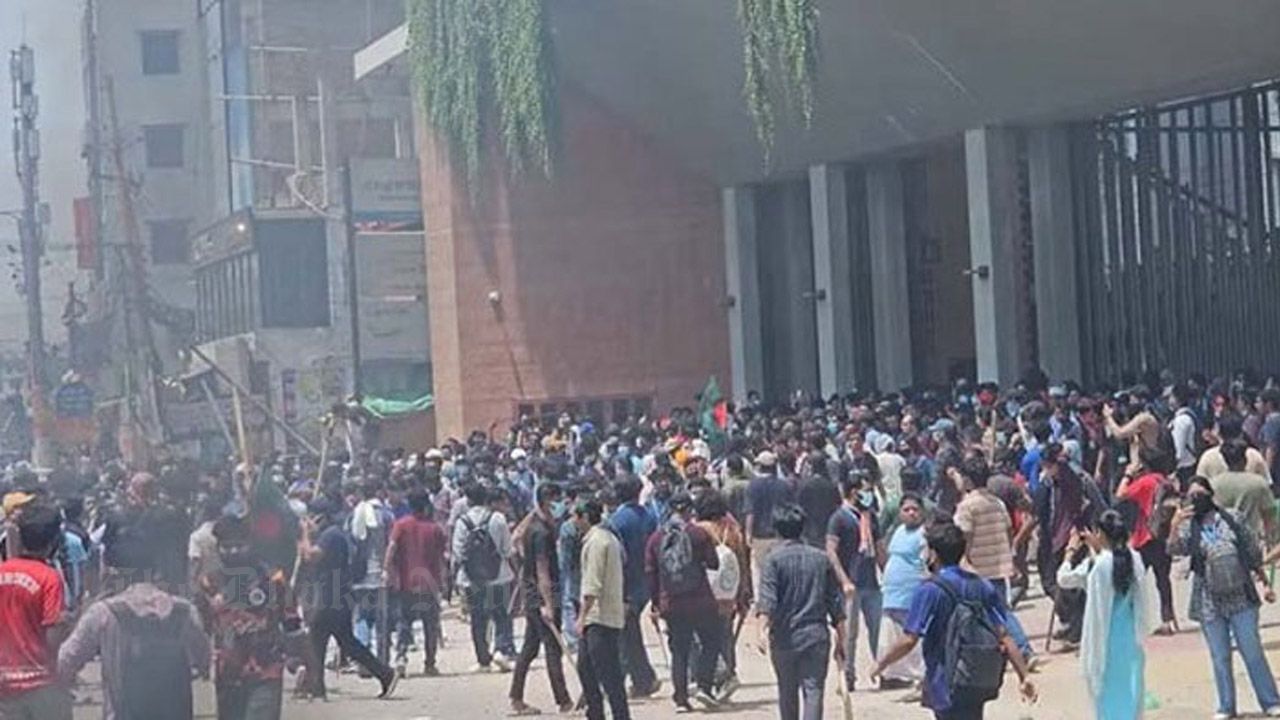
The anti-discrimination student movement intensified dramatically on 18 July 2024, with students from private universities across Dhaka emerging as a major force in the nationwide protests against the government of then Prime Minister Sheikh Hasina.
The escalation came a day after security forces carried out a crackdown on the University of Dhaka campus on 17 July, leading to the evacuation of residential halls in an effort to suppress the growing student movement. The following day, demonstrations rapidly spread across the capital as students from numerous private universities joined the protests, transforming the movement into a nationwide uprising.
From that point onward, protesters accused members of the Awami League later declared a banned organization and law enforcement agencies of carrying out coordinated and violent attacks on students and civilians. At the same time, authorities imposed internet restrictions while security forces intensified operations across the country.
Beginning early on 18 July, repeated clashes broke out between police and students demanding quota reform in front of BRAC University in Badda, bringing traffic in the Merul Badda area to a standstill.
At approximately 11:00 am., police entered the campus of the Canadian University of Bangladesh in Merul Badda while demonstrators gathered outside. According to protesters, officers fired birdshot and rubber bullets from inside the campus, seriously injuring numerous people.
Despite the operation, protesters mounted strong resistance, preventing police from leaving the campus for several hours. Shortly before 3:00 pm., two helicopters were deployed to evacuate the stranded officers.
The quota reform movement quickly gained widespread public support. In addition to Badda, major confrontations took place in Uttara, Rampura, Malibagh, Dhanmondi, Mirpur, Nilkhet, Azimpur, Tejgaon, Shantinagar, Mohakhali, Shanir Akhra, Kajla, and Jatrabari, among other parts of the capital.
Throughout the day, large sections of Dhaka witnessed intense clashes between protesters and security forces, effectively turning many areas into battlegrounds.
The unrest rapidly expanded beyond the capital. Clashes involving protesters, law enforcement agencies, and activists from the Awami League and its affiliated organizations were reported in Chattogram, Cumilla, Narsingdi, Narayanganj, Barishal, Mymensingh, Khulna, Rangpur, and Rajshahi, among other districts.
According to reported casualty figures, 18 July became one of the deadliest days of the July Mass Uprising, with 27 people killed nationwide including 19 in Dhaka and eight elsewhere while approximately 1,500 people were injured.
Nationwide "Complete Shutdown"
Responding to a call from the Anti-Discrimination Student Movement, students observed a nationwide "Complete Shutdown" on 18 July.
The movement's principal demands included:
> Condemnation of what protesters described as the excessive use of force and killings by the police, Border Guard Bangladesh (BGB), Rapid Action Battalion (RAB), and the police's Special Weapons and Tactics (SWAT) unit during the quota reform protests;
> Accountability and exemplary punishment for those responsible;
> Safe, violence-free educational institutions; and
> A rational reform of the quota system.
The shutdown effectively paralyzed much of the country. Protesters blocked major highways and railway lines, severing transport links between Dhaka and other regions. At approximately 5:30 p.m., metro rail services were suspended for security reasons.
During multiple rounds of clashes, a fire broke out at the headquarters of the state-owned broadcaster Bangladesh Television (BTV), forcing it to suspend transmission at 7:00 pm.
Reports also emerged of attacks on the Bridge Authority Building (Setu Bhaban), the Disaster Management Building, several police facilities, and the Mayor Hanif Flyover toll plaza.
Outside Dhaka, protesters vandalized a number of government installations amid the unrest. Incidents of attacks and counterattacks were reported at district administration offices, police stations, government buildings, and Awami League offices in Satkhira Sadar, Phulpur (Mymensingh), Madaripur, Rangpur, Bogura, and Habiganj.
As the situation deteriorated, the government ordered the nationwide deployment of Border Guard Bangladesh (BGB) under the direction of the then Home Minister.
Later that night, broadband internet services were completely shut down. Mobile internet had already been suspended on 17 July, leaving Bangladesh under a near-total internet blackout on 18 July.
At around 12:00 am., Asif Mahmud Sajib Bhuiyan, one of the coordinators of the Anti-Discrimination Student Movement who later became an adviser to the interim government informed journalists via text message that the nationwide "Complete Shutdown" would continue on 19 July.
A subsequent fact-finding report by the Office of the United Nations High Commissioner for Human Rights (OHCHR) concluded that widespread human rights violations and abuses of power occurred during the protests in Bangladesh in July and August 2024.
According to the report, a meeting of the government's Core Committee was held on 18 July under the chairmanship of the then Home Minister. Senior officials from the police, BGB, RAB, the Bangladesh Army, the Directorate General of Forces Intelligence (DGFI), and other security and intelligence agencies attended the meeting.
The report stated that participants discussed extensive arrest operations, including block raids. It further alleged that the decision to shut down the internet was ordered directly by the then Home Minister with the intention of concealing serious human rights violations, facilitating arbitrary arrests, and obstructing peaceful protests.

মঙ্গলবার, ১৩ অক্টোবর ২০২৬
Published : ১৮ জুলাই ২০২৬
Stay connected with The Dhaka News